Embracing Omni channel Retailing: The Future of Service Retail

In today’s fast-paced retail environment, the line between online and offline shopping experiences is increasingly blurring. This is where omni channel retailing comes in – a seamless fusion of digital and physical shopping experiences. For service-based businesses like spas, hairdressers, and fitness centres, embracing omni channel strategies, such as BOPIS (Buy Online, Pick Up In-Store) and contactless technologies, is becoming essential.
Traditionally, BOPIS has been a strategy used by product-based retailers. However, service retailers can also leverage this by productising their services. Consider offering gift cards or certificates online that can be redeemed in-store. This not only simplifies the purchasing process but also attracts customers to visit your physical location, enhancing the chance of additional sales or bookings.
The in-store experience is crucial in service retail. It’s about creating an environment that reflects your brand and makes customers feel welcomed and valued. This can range from the interior design of your space to the quality of customer interactions. A well-designed, inviting space can significantly enhance customer satisfaction and loyalty.
Integrate Online and Offline Data: Ensure that your online platforms and in-store systems are synchronised. This helps in understanding customer preferences and tailoring services accordingly.
Mobile Integration: Develop a mobile-friendly booking system for your services, allowing customers to book appointments easily from their phones.
Personalised Marketing: Use customer data to send personalised offers and recommendations via email or text.
Train Staff for Omni channel: Ensure your staff is trained to handle both online and in-store customer interactions seamlessly.
Leverage Social Media: Use social media platforms not just for marketing, but also for customer service and engagement.
At Desketing, we understand the intricacies of omni channel retailing, especially in the service sector. Our expertise lies in creating integrated marketing strategies that resonate with your brand and meet your customers’ needs. From website design to in-store branding and digital marketing, we offer comprehensive solutions to elevate your retail business.
Interested in exploring omni channel strategies for your service retail business? Contact Desketing today to discover how we can help transform your customer experience and increase sales.
The Future of Retail in Australia: Trends to Watch in 2024
As we approach 2024, the Australian retail landscape is poised for significant evolution, blending physical and online experiences more seamlessly than ever before. Here’s what retailers and consumers alike can expect:
While online shopping continues to grow, physical stores remain vital, accounting for a significant share of total sales. The key to success lies in convenience-driven strategies, like buy online, pick-up in-store (BOPIS) options, and contactless shopping technologies. The rise of dark stores for urban fulfillment and integrated delivery services through strategic partnerships are trends to watch closely.
Despite challenges, the Australian economy has shown resilience. A shift in consumer spending has been noted, with a focus on essential items over discretionary spending due to increased living costs and interest rates. Retailers have adapted by offering discounts, especially in non-food sectors. With expected wage growth and population increases, the retail sector is gearing up for gradual growth in 2024.
High household debt levels are shaping spending patterns. With interest rates higher than in the previous decade, consumers are becoming more budget-conscious. This trend is likely to continue, with a focus on reducing debt-servicing costs. However, the forecasted slight decrease in policy rates by the end of 2024 may offer some relief.
In 2024, Australian retailers must adapt to a market that demands a balance of online and physical retail experiences, focusing on convenience and efficiency. Economic factors will continue to influence consumer behaviour, prompting a cautious approach to spending. Retailers must respond with innovative omni-channel strategies and a commitment to providing value through discounts and convenience.
As we navigate these changes, Desketing is here to help retailers adapt and thrive. Our expertise in omni-channel marketing strategies and our deep understanding of the retail landscape position us to support your business in these evolving times.
Ready to transform your retail strategy for 2024 and beyond? Contact Desketing today and let us guide you through the future of retail.
3 Steps to Create a Stunning Marketing Campaign for Valentine’s Day

Valentine’s Day is a great opportunity for retail businesses to show off their products and services and connect with customers. If you want to create a memorable and successful marketing campaign, here are three steps to follow:
Before starting any campaign, it’s important to have a clear idea of what you want to achieve. What are your goals for this Valentine’s Day campaign? Are you looking to increase sales, build brand awareness, or promote a new product? Defining your objectives will help you create a campaign that is focused and effective.
Once you know what you want to achieve, the next step is to plan your campaign. This includes deciding on the channels you want to use, such as email, social media, or print, and creating a timeline for your campaign. You’ll also need to decide on the products or services you want to promote, and the offers or discounts you want to offer.
Finally, to create a successful campaign, it’s important to make it creative and memorable. Use eye-catching graphics and bold, romantic colors to capture your customers’ attention. Use storytelling and emotional appeals to create a connection with your customers and make them feel special.
At Desketing, we understand the importance of creative marketing and can help you create a stunning Valentine’s Day campaign that delivers results. Contact us today to learn more about how we can help you celebrate this special day and drive sales for your business.
With only two weeks until Valentine’s Day, it’s important to act now and start planning your marketing campaign. Use these three steps to create a campaign that connects with your customers and helps you reach your objectives. Happy Valentine’s Day!
Retail marketing calendar 2023
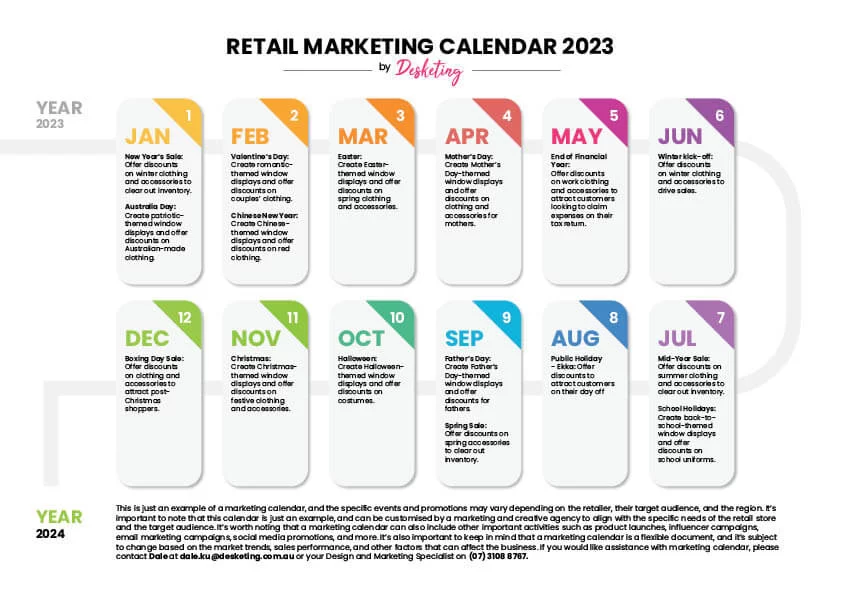
Retail marketing in Australia is a highly competitive and dynamic field, with retailers constantly looking for ways to stand out and drive sales. One important tool in the retail marketer’s arsenal is the marketing calendar. This is a schedule of planned marketing activities and promotions that aligns with key retail events and holidays throughout the year.
In Australia, key retail events and holidays include Valentine’s Day, Easter, Mother’s Day, Father’s Day, and the Christmas period. These events present opportunities for retailers to create special promotions, sales and events to drive foot traffic and sales.
Marketing calendars can also be used to align promotional campaigns with other key events and holidays that may not be directly related to retail, such as public holidays, national events, and school holidays. These events can also drive consumer behavior and can be leveraged to boost sales.
Error: Contact form not found.
Need more help with developing an effective marketing plan? Our Brisbane team of design and marketing experts are experienced in developing tailored, measurable results-driven campaigns. Check out our Masign marketing packages to learn more!
In order to develop and execute a successful marketing calendar, retailers can benefit from working with a marketing and creative agency. These agencies can provide a range of services, including:
- Researching consumer trends and behaviours to identify key events and holidays that align with the retailer’s target audience.
- Developing marketing strategies and campaigns that align with the retailer’s brand and target audience.
- Creating visually appealing and engaging in-store displays and packaging to promote products and drive sales.
- Developing and executing social media campaigns, email marketing, and other digital advertising to reach target audiences.
- Optimising websites and online stores to improve user experience and increase conversion rates.
By working with a marketing and creative agency, retailers can ensure that their marketing efforts are aligned with key retail events and holidays, and are tailored to the specific needs of their target audience. This can help retailers to maximise their sales, increase their market share, and achieve their business goals.
In conclusion, a marketing calendar is a powerful tool for retailers looking to drive sales and increase their market share. By aligning marketing efforts with key retail events and holidays, retailers can tap into consumer behaviour and drive sales. Retailers in Australia can benefit from working with a marketing and creative agency to develop and execute a successful marketing calendar that aligns with their target audience, and helps them to achieve their business goals.
5 Marketing Tips To Improve Your Healthcare Business
Are you one of the medical practices that keep lusting after more referrals and dropping prices only to boost sales and gain patients? Have you ever wondered if there are other ways to advance your medical business in the long term?
Look no further – here are five fresh tips to help you grow your medical healthcare business.
#1. Good Branding Matters
The cornerstone of any successful business – is a distinctive and recognisable branding that stands out from your competitors. A good brand identity is the most immediate way you have of expressing your distinctiveness. It tells your customers how different you are (see examples here). Good branding of a comfy and stress-free clinic gives you the power to identify yourself as the unique shape that stands the test of time and instils trust in customers’ minds.
#2. Make New Connections
Referrals from other healthcare professionals are the most powerful marketing tool in the medical industry. In no doubt, it helps acquire potential customers and further strengthen the brand image. Therefore, it is vital to building good connections with the healthcare professionals in your community. Attending medical and healthcare networking events helps put your reputation out in the marketing, and even so, hosting your own educational healthcare networking nights allows the building of quality connections with other professionals.
#3. Improve the Patient Journey
An impression of medical practice is firstly represented by a mature booking system. Establishing an all-in-one medical booking system that integrates into your website or clinic software can be translated into a seamless online experience for patients looking to answer a question or book an appointment. A mature internal medical system reduces the potential frustration of booking, acts as a powerful communication channel, and effectively shapes patient satisfaction.
#4. Showcase Your Expertise
Your website is the interface of your whole business. The patient journey does not stop at the booking system – it carries on to a well-designed, premium website optimised for conversion, which helps communicate your professional knowledge to the community. Your unique insights on healthcare topics can be showcased in the forms of webinars, case studies, blog posts, videos, infographics, and patient stories on a tailored website (see examples here).
#5. Use the Power of Graphics
An image of a doctor is worth a thousand words. Content is key in medical marketing. Not just any content – visual and graphic storytelling is king. Professional photography and videography convey the message of trustworthiness. Nothing says more than a real-life photo or video of your specialists and experts; most importantly, a direct demonstration is a compelling way to connect with customers on a deeply human level.
Times have changed – in a big way. In the past, patients had little choice in which medical practices they visited. Yet, as all have realised, the balance of influence in the healthcare brand-consumer relationship has swung to the consumer. Fortunately, there is no shortage of ways to deliver the best medical marketing strategy; therefore, it is essential to remain open to changes to stand out.
Desketing medical marketing provides all-in-one solution to your medical business.
Contact us for more information here.
Speak with Desketing Medical Marketing
Products with purpose

As brand authenticity and transparency become ever more important to a business’s success, we have seen a remarkable surge in social enterprise and ethically-charged brands. In this article, we discuss ethical marketing and take a look at how 3 Australian brands are working hard to make a difference.
Ethical marketing refers to the process by which companies market their goods and services by focusing not only on how their products benefit customers, but also how they benefit socially responsible or environmental causes.
Social enterprises are businesses that sell products and services to intentionally tackle social problems, such as improving communities, providing access to employment and training, or helping the environment.
From a marketing standpoint, these ethical and social enterprise brands not only communicate the benefits of the product or service they are offering, but also communicate how they are contributing to improving society.
The following examples show the principles of ethical marketing in action, as well as why championing good causes is so effective for today’s brands.
#1 – Trademutt
TradeMutt is a social impact workwear that produce funky, eye catching workwear designed to start conversations about mental health among the blue collar community – helping make an invisible issue impossible to ignore.
Through the sale of their products, they help fund free and unlimited professional mental health support for tradies, truckies and blue collar workers.
Join us as we catch up with Ed and Dan from Trademutt at our next networking event.
# 2 – Thankyou
Thankyou produces a range of fast moving consumer goods. After expenses, Thankyou distributes funds to life-changing food, water and health and sanitation programs around the world.
#3 – Who Gives a Crap
Who Gives a Crap make all of their products with environmentally friendly materials and donate 50% of profits to help build toilets for those in need.
Join Networking Connexions for an exclusive networking event focused on community building and engagement.
During this networking event, you’ll have the opportunity to learn key insights and strategies for successful community building and tactics for driving engagement.
Special Guests: Edward Ross & Daniel Allen
Ed and Dan are co-founders of Trademutt – a booming workwear brand with a conscience. Building a huge following through their conversations around mental health – These guys have a wealth of knowledge about starting conversations and engaging with their audience.
Tune in to hear their insights into audience building and the secrets to reaching and engaging with your target market.
Join our mailing list for more marketing insights!
Building an audience for your brand
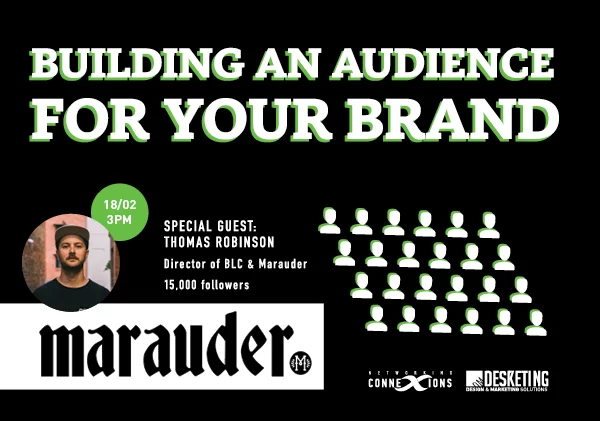
For businesses of all sizes, building an audience base is one of the most crucial aspects of business operations. However, many businesses find it to be one of the most challenging. Although you might have a great product or service, it can still be difficult to connect with people who are interested in what you have to offer.
We caught up with Thomas Robinson, brand manager for Marauder and BLC Apparel – two lifestyle brands with an impressive online following, to develop our top tips for business owners looking to expand their audience.
Tip 1 – Really understand your audience
The first and arguably most important step to building a brand is to define your audience. Thoroughly evaluate your product and/or services and identify who would benefit from using your brand.
You can help define an audience for your product or service through demographic segments like age, gender, location – or through social aspects like lifestyle, interests and behaviours.
Too many people often fail by trying to be too diverse. They often strive to engage everyone and will bend over backwards to try to make everyone happy.
The target audience are those individuals who are most likely to buy products or services. Don’t try to over-reach by engaging other types of consumers.
“Everything we promote and market with our brand, we do and live ourselves. I’ll be 40 and still skating and listening to punk if my body lets me, and for the people that support our brand I know it runs just as deep with a majority of them.”
Tip 2 – Align your brand identity with your audience
The tone of your brand’s messaging should match the tone of your audience. It’s the like-mindedness and connection between your brand and your audience’s lifestyle that draws in consumers. Consistency with your business’s offering is key – if your audience is focused on a specific niche category, you don’t want to stray from it. Otherwise, you could lose some of the audience you’ve already collected.
“Our inspiration comes from the lifestyle, I think the brand is a co-product of Joel and My pure desire to keep pushing things as far we can, always thinking ‘how can we do this better?’ Whether it’s a design or direction for collaborations or revisiting past ideas and bringing new life to them, most of all we are fans of everything we do -so we are constantly on the lookout for that spark that inspires us and bring it into our space and language.”
Tip 3 – Learn what you can from your existing audience
Examine the priorities, engagement habits, buying behaviours, favoured pricing, social media activity, and other details of your current audience for commonalities. Then, use this data to inform or refresh your outreach.
Consistently trying new tactics and fresh methods based on the data you gather about your existing audience will help you maintain a steady stream of new connections. The key to success is to use what you know, build on what you learn, and always be on the lookout for ways to expand.
“We are digging deeper into what we are personally and what makes us interested in a brand and then putting it to a few customers we have great relationships with and getting real time feedback, that’s the great thing about social media it’s an instant yay or nay.”
Join Networking Connexions for an exclusive business event focused on building an audience for your brand.
During this networking event, you’ll have the opportunity to learn and discuss the key strategies for successful audience building and tactics for driving engagement with your target market.
Special Guest: Thomas Robinson
Thomas has founded a number of popular lifestyle brands including Marauder Clothing and BLC Goods, with an engaged audience of over 15,000 followers. From humble beginnings of boutique e-commerce offerings, his brands are now stocked nationally in large retail chains.
Tune in to hear his insights into audience building and the secrets to reaching and engaging with your target market.
Register now!
Tip 4 – Inhabit the same spaces as your audience
You need to utilise as many channels as possible if you want to reach more of a consumer-base. By using a diverse range of channels, you can broaden the audience you reach. It is important to consider what channels are the most relevant to your audience. Common channels include:
- Website
- Blog
- Social media platforms such as Facebook, Twitter, Linkedin, Instagram, Snapchat and TikTok
- Emails
- In-store communications
Creating consistency across channels
When all channels work together to create a unified message, voice, and a brand for your company, this is known as omnichannel marketing.
Campaigns using 3 or more channels (for example, email, banner ads, and social media) have a 90% higher retention rate than single-channel efforts.
Omnichannel marketing ensures that your potential and current audiences receive 1 unified, consistent message that reflects how they have interacted with your brand.
“We have great success lately with having boots on the ground, being out and about doing events or just hanging out. Our target customers are at gigs or skating and we just happen to be there partaking in person chatting to them. People are in their own element and don’t feel like we are marketing to them, we just let them know we run this brand and give them a history run down of what it is about, and oddly enough we have been very lucky with customers purchasing that same day.”
Tip 5 – Produce great Content
One of the best ways to build an audience is to make sure you’re creating great content. Whether you’re creating YouTube videos or writing blog posts, it’s all about creating content relevant to the brand and giving the audience information they want and need. This material should leave your audience reader fulfilled in some fashion.
Giving your audience something to read, use or watch assures them that you are a reliable brand that will meet their consumer needs.
“I feel like anything transparent these days is engaging and stats also prove it. That avenue shows humility behind a company and my focus this year is to really lean on that and bring people more behind the scenes with all the cool stuff we have happening. People like to feel they are part of the process and once the product launches they feel more emotionally invested because they have seen it from the start.”
Tip 6 – Consider Cross-promotion and influencer marketing
There are likely to be other brands that target your exact audience with products or services that don’t compete with what you offer. Consider sharing your marketing messages with their audience, and vice versa.
Partnerships, co-sponsored events, and other collaborations can lift brand awareness and create positive associations with an existing product that your audience is already using. Engaging with influencers can be a great way to establish a connection and get your brand in front of a new audience.
“We pick some influencers with if they have heard about the brand and care enough to treat it like something than just a transaction, that’s why we use our friends as models because we know they are going to do all they can to make sure everything turns out epic. But we have seen great social growth with some influencers, so we will be using more in the future also.”
Join our mailing list for more marketing insights!
2021 Vision: Key Dates for Retail Marketing

Retail marketing ebbs and flows with seasonal changes, holidays, events and special occasions. Special holidays today serve as benchmarks for higher spending. Most, if not all, holidays are attributed to a spike in consumer spending.
Thus, business owners both big and small should promote heavily around holidays to maximise these opportunities to boost their revenue.
Occasions-based marketing can be hugely profitable for ecommerce and retail brands – providing seasonal and topical angles for all kinds of sales and campaigns. Knowing these key dates will allow you to plan in advance and prepare to increase sales with strategically timed marketing campaigns.
We have created this guide to help you identify key marketing opportunities for promotions, sales, social media content, emails and more. We have included a free marketing calendar in this guide, so you can easily visualise upcoming promotional dates, or integrate with your iCalendar.
Error: Contact form not found.
Need more help with developing an effective marketing plan? Our Brisbane team of design and marketing experts are experienced in developing tailored, measurable results-driven campaigns. Check out our Masign marketing packages to learn more!
1st – New Year’s Day
In conjunction with Boxing Day sales, New Year gives retailers the opportunity to make the most of huge foot traffic in shopping centres and engaged online shoppers.
26th – Australia Day
Sun and sand, perfect for retailers selling recreational and leisure products for shoppers to use on the public holiday.
27th – Back to school (QLD)
Huge for stationery stores, office items and school supplies.
7th – Super Bowl Sunday
A huge day in the US, and getting bigger across the world – give your brand/social an NFL focus for the day.
8th – Australian Open Starts
Australia’s largest tennis event and the first of four Grand Slams. Tennis provides many powerful visual cues to incorporate into your sales.
12th – Chinese New Year
A 15-day festival, try running some sales with a Chinese or oriental theme.
14th – Valentine’s Day
Retailers who sell products that work well as gifts should promote heavily in the weeks leading up to this romantic day.
1st – Autumn Begins
This season evoke those crisp and cozy feelings – think about incorporating leaf, wood and natural tones into your imagery. Maybe try some alliteration with a Fall Flash Sale?
8th – International Women’s Day
Connect with your female audience and show your support for equality.
17th – St Patricks Day
The biggest day of the year for many Irish pubs. Try and incorporate green themes to engage with your audience.
1st – April Fools Day
Many brands have received high engagement through sharing fake products on this date. How will you get a laugh out of your audience with a prank?
2nd – 5th – Easter Weekend
Other than Christmas, this is usually the longest break people get all year. Take advantage of this free time by promoting recreational and leisure products.
7th – World Health Day
If your products or brand have healthy theme, consider running a flash sale or promotion.
22nd – Earth Day
The perfect opportunity to promote your environmentally-friendly or sustainability practices.
5th – Cinqo de Mayo
Great for hospitality and food venues to create themed menus. How can you associate your brand with Mexico on this day to grab some attention?
9th – Mother’s Day
Perfect for both retail and hospitality, everyone loves showing their appreciation for their mother with beautiful gifts or a nice meal.
1st – Beginning of Winter
A great time to promote comfort and showcase warmer products.
9th – State of Origin
The first of 3 games, Origin is one of Australia’s most widely viewed sporting events. This is a great opportunity for you to connect with your online audience by wearing your team colours.
30th – End of Financial Year
EOFY is all about beating the June 30 deadline – a great way to introduce urgency into your campaign or sale.
4th – NAIDOC Week Starts
A week to celebrate the history, culture and achievements of Aboriginal and Torres Strait Islander peoples. An opportunity to engage with your audience by showing support.
8–11th – Christmas in July
Christmas in July is growing in popularity in retail businesses. It can provide a good retail focus and sales kick in between major seasons.
11th – Ekka Public Holiday
A time associated with fun and excitement for Brisbane residents – consider incorporating these themes into your marketing during this period. Take advantage of the local public holiday to get traffic through the door.
1st – Beginning of Spring
A fresh theme that exudes joy and the breath of new life that comes with the season. Retailers could consider a ‘Spring Cleaning’ stocktake sale.
4th – Spring Racing Carnival begins
A massive Australian tradition celebrating the sport of racing, the social element and the fashion of the races. Here is an opportunity to use the classy and exciting themes of the racing carnival to associate with your brand.
5th – Father’s Day
Promote this holiday many weeks before if you sell anything that works well as a gift for men. Automotive, sport in equipment or memorabilia, home improvement, clothing and gadgets all sell well during this period.
23rd – Footy Finals Fever
The time of year when both AFL and NRL are approaching their grand finals. Tensions and fan passions are high, which make this time huge for hospitality venues, who should consider package deals to increase average spend. Connect with your audience (or make enemies) by showing support for your team.
4th – Queens Birthday (QLD)
A holiday associated with pampering, luxury, and class – perfect for spas or retailers selling luxurious products.
7th – 10th – Bathurst Weekend
Australia’s largest motor racing meet, and probably the one day that we think about cars more than any other. Great opportunity to align your branding with speed, adrenaline and excitement.
31st – Halloween
Huge if you sell anything related to costumes or horror, but also an opportunity to run some special Halloween sales.
1st – Movember Starts
A time to reflect on male health, consider running a campaign if you sell products targeted at males.
18th – Grand Prix
Attracting class and excitement, the Grand Prix is one of Australia’s largest racing events. Consider incorporating the event into your marketing if your products lend themselves to adrenaline junkies.
25th – 29th – Thanksgiving Weekend (Black Friday, Cyber Monday)
One of the biggest weekends in the retail calendar. Shoppers have come to expect the biggest savings of the year during this period.
1st – Beginning of Summer
Although this marks the start of Summer, here in Queensland it feels like Summer started months ago – so this is really more about the lead up to Christmas. Stores have decorations up and foot traffic builds steadily towards the end of the month. Hospitality venues should consider their offerings for Christmas parties and end-of-year events.
26th – Boxing Day
Get those post-holiday sales up and running! The busiest day in Australian retail, shoppers expect huge discounts.
31st – New Years Eve
The biggest night of the year for bars and the greater alcohol industry. Brands could consider thanking their audience for their support through the year, or reflect on their achievements.
Error: Contact form not found.
A Guide to Achieving Goals for your Retail Business

What if our goals were just dreams, with a deadline?
With each new year, there are new resolutions, new promises and new goals being made. However how many of us make goals and find themselves not achieving those goals, not seeing it through or changing their goals too often*. (*Waves both hands frantically in the air). What was getting in the way of achieving the actual goal?
What you will get from this article:
- Learn why goal setting is important
- Understand how to create goals that inspire you
- Tips on transforming your goals from concept to reality
- Access to a strategy workshop with Desketing
Learn about our secrets and tips on how to set goals and create a future for your retail business.
#1 Goals set the benchmark for success.
Why is goal setting important to your retail business?
Goal setting is not a simple case of saying or writing down, ‘I want to make a million-dollar business’. The definition of goal setting is the process of identifying what you want to accomplish and creating measurable objectives and timeframes to achieve them.
Sitting down with our retail clients, the importance of goal setting becomes so much clearer, because without goals and objectives, how do you determine success?
Not setting goals is a surefire way of avoiding disappointment over unrealistic goals, but setting goals is also a surefire way of discovering a sense of achievement.
Top things to remember
- Goal setting is the vehicle that will drive you to your desired destination.
- Goal setting keeps you accountable
- Goal setting will help you overcome procrastination
- If you don’t know what you want to achieve, you can’t create an action plan to get there
#2 Create important, motivating, compelling, inspiring, get out of bed goals.
Set effective goals that are important to you and offer you value in achieving them. If you have little interest in the outcome, then chances are you won’t do the work to make it happen. This is particularly critical for retail business and franchises, because setting goals require commitment, feeling a sense of urgency and a must-have attitude. If you don’t have the motivation, then you’ll do what most of us do, and end up putting off what you need to do to make the goal a reality. We’re likely to do the work and put in the time and energy when the end goal in sight excites us and is the driving force behind our actions.
Let’s change our mindset when it comes to goals. What if our goals, were just dreams, with a deadline? Then all we have to do now is create an action plan to achieve.
#3 Transform your goals from concept to reality
SMART goals stand for smart, measurable, relevant and time-bound. Transforming your goals from concept to reality involves well defined, clear and real goals.
Be sure to set precise amounts and dates so that we have that benchmark to measure. They need to be real goals because there’s no point in setting goals that will lead to demotivation and tear down your confidence. Setting realistic goals will give you and your team a sense of achievement.
#4 Progress equals happiness
Don’t underestimate the power of small wins. Setting progressive goals that allow you to feel like little achievements help us to move on to bigger achievements. Sometimes it’s the little motivations, that lead to small goals, which lead to progress which leads to leading a team that feels fulfilled and happy.
#5 Determine Your Process
You have to understand the difference between goals and process. Think of yourself as a small rowboat. Your goals are the rudder on the boat and give you direction. If you commit, it keeps you forward, and if you chop and change between goals, then you’ll find yourself in circles.
The oars are your process and determine your success.
While goals set the direction, the process determines your progress. And as we mentioned before progress equals happiness.
You’ll get nowhere from just holding onto the rudder, you have to row.
If you’re a runner and your goal is to run a marathon. Then your process is an 8-week training schedule.
If you’re the owner of a retail business and your goal is to build a million-dollar business. Then your process is a sales and marketing plan.
Click here to book a goal-setting strategy with Desketing.
#6 Set daily reminders
Transform your goal into a reality involves writing it down, telling people, telling yourself every single day! Whether that includes putting your goals around your office, on your walls, desktop computer screen, bathroom mirror, Trello, Skype, Whatsapp, email and calendar alerts. Setting constant reminders keeps you motivated, helps you visualise and understand why you’re doing this.
#7 Do you have the skills or resources to make it happen?
Goal setting is not just about choosing the rewards, but also accepting the need for the skills and resources required to make them happen.
For retail businesses, a strategic sales and marketing plan involves a detailed action plan that includes regular marketing campaigns and a rollout including signage, posters, email marketing, mobile marketing, Google Ads and social media marketing.
Do you have the skills or resources to make it happen? Schedule a meeting with our team of design and marketing experts to keep you focused.
Are you ready to take the next step and learn how to set business goals you will achieve?
Ask us about Goal-Setting Strategy Workshop
Fill in your details below and we’ll get in contact shortly.
Error: Contact form not found.
7 Tips for Results-Driven and Effective Franchise Marketing
Behind every great franchise brand, is one key element and that is the power of marketing to support it.
Franchise Marketing is no easy feat. For franchisors and franchisees, it takes a level of dedication, passion and vision to strengthen the brand and see yearly profitability. So why do some franchises flourish and others fail?
We delve into the complexities and challenges that a franchise faces and provide seven results-driven and effective franchise marketing tips to help franchisors and franchisees to see consistent growth and build their brand power.
Tip #1 Franchisees feedback is invaluable
With franchises, stakeholder management is key here, particularly with franchisees. Make sure that you involve franchisees at every step of the process particularly if want their marketing support.
Getting the franchisees on board, will let them feel involved and let them feel and know that their opinions matter. It’s important to understand that their feedback is important, particularly as they interact the most with their customers. By giving franchisees a sense of ownership, they’ll feel like they own the brand and want to support the marketing behind it.
Tip #2 Tailor the Marketing for the Locals
There isn’t a one size fit all model when it comes to franchise marketing. Talk to franchisees about local area marketing to support the national marketing campaign, it’s important that the key marketing messages are being communicated to your audience effectively and accordingly to the demographics and behaviour of your audience. Give franchisees the opportunity to contribute to local area marketing such as local sporting organisations or charities, advertising in local newspapers, competitions, customer referral incentives and local billboards.
Tip #3 Offer Guidance, Not Assumptions
If you’re looking for clear and measurable results, it’s vital that franchisees are doing everything correctly to deliver the campaign. Communicate with franchisees on the requirements and processes so that they are able to communicate effectively with their team. Offer ongoing guidance and frequent communication and the results will speak for themselves.
Tip #5 Attract the Right Franchisees
One of the key challenges of any growing franchise is attracting the right franchisees. Prospective franchisees will gravitate towards franchise brands that provide them with quality information that is easy to digest and clear.
There are plenty of ways that franchisors can help to provide this information and to attract quality prospective franchisees and these include:
- Provide downloadable online information kits;
- Attract and qualify prospects by providing an online FAQ section;
- Keep your listings on franchise business websites up to date with current information and make sure that they’re optimised with the right keywords;
- Update your website often and optimise your web pages for the right keywords so they appear on Google searches;
- Use social media channels such as LinkedIn and Facebook to advertise business opportunities.
Tip #6 Behind a Strong Brand is Consistent Marketing
A key difficulty for franchises is ensuring that a consistent message is being to prospective and current customers from the franchisor and all the franchisees. Ensure that franchisees understand the importance of message consistency by communicating clearly defined messages, goals and objectives. Franchisors need to protect their brand by creating strict rules about how the trademarks are used and also with the creation of advertising and marketing materials.
Tip #7 Build Your Brand With a Comprehensive Marketing Plan
Franchisors and their Franchise Brand will benefit greatly by developing and executing a comprehensive marketing plan for the overall franchise. Commitment and execution are key here, while also having the right team with the right skill level to deliver clear and measurable results.
The Marketing Plan should consist of a promotional schedule that includes clearly defined messages and goals along with the scheduled advertising campaigns. Different promotional channels can be implemented including tv and radio commercials, social media, public relations, direct mail and digital marketing. A successful campaign is one that is results driven and measurable and focused on key goals such as brand awareness, increasing foot traffic to stores, increasing leads and enquiries.
Desketing are experienced and trusted franchise marketing and design specialists.
Having worked with variously sized franchises, Desketing is experienced to help nurture and consult franchises on marketing campaigns and provide marketing and design support for point of sale materials including menus, posters and displays, catalogues brochures and other print material.
Desketing is furthermore helping franchisors to integrate digital marketing into their overall strategy for example through franchise website development, maintenance, search engine optimisation, digital advertising including Google Adwords and Display Advertising and social media advertising.
You can speak to a Desketing design and marketing specialist by calling 07 3220 3962 or request a callback.